BRAVA Award Winner 2026 – Priscilla Dobler Dzul
Congratulations to our 2026 BRAVA Award Special Choice Award: Ceramics Artist winner, Priscilla Dobler Dzul.
The BIMA Recognizes Achievement in the Visual Arts (BRAVA) Awards are an annual award that honors four exceptional contemporary artists, craftspeople, or makers whose work demonstrates artistic excellence, technical mastery, and meaningful contributions to the arts community. The awards is presented in four categories, recognizing individual achievement and the broader impact these artists have had on the arts landscape.
Continue reading to learn more about this category, Priscilla Dobler Dzul, and her work.
Category: Special Choice Award: Ceramics Artist (Puget Sound Region)
The BRAVA Award for Ceramic Artists supports contemporary visual artists and craftspeople whose primary practice centers on clay and ceramic processes. This award recognizes artists working across functional, sculptural, and conceptual approaches, including wheel-thrown, hand-built, slip-cast, experimental, or interdisciplinary ceramic work. Artists may explore traditional techniques, contemporary forms, or innovative uses of material, scale, surface, and firing methods, demonstrating technical mastery alongside a distinct artistic voice.
This award is open to artists based in the Puget Sound region, which includes Skagit, Snohomish, King, Pierce, Thurston, Mason, Jefferson, Whatcom, Clallam, Kitsap, Island, and San Juan Counties.
About Priscilla Dobler Dzul
Priscilla Dobler Dzul is an interdisciplinary artist; she grew up in the industrial redlined section of South Tacoma, an area with the highest rates of pollution in Tacoma, the least amount of tree canopies, and a superfund of 128 acres on top of Tacoma’s aquifer system, South Tacoma Groundwater Protection District, which is being destroyed to build an international mega warehouse. Her inspiration comes from her passion and commitment to the preservation of land, oral stories, craft, and representation of her multi-Maya cultural heritage. Her research is driven by a commitment to narrative change through social justice, racial equity, and artistic mastery.
As a child, she spent her summers cleaning apartments with her mother. She witnessed first-hand physically forced evictions, domestic violence, racism, and sexism towards members of her community, family, and self. These themes recur in Priscilla’s artwork. Priscilla’s Maya grandpa and Scottish-German grandparents took her to painting and pottery classes and taught her how to garden while studying native plants. Her Scottish Grandma Ruby introduced her to the industrial rope Henequen and told her how shipping yards in Glasgow imported them from Yucatan. Her Maya grandfather told her oral stories of Maya warriors and folklore. Her Maya aunties helped her with sewing projects. It’s through these experiences of labor, love, and resilience that Priscilla understood the importance of community and how craft and folk art both shows our stories and our relationship to the ecosystems.
She has exhibited domestically and internationally. Most recently she has shown at the Museo de Arte Contemporaneo de UChile, Santiago, Chile; Frye Art Museum, Seattle; 32nd Biennial de Pontevedra, Galicia, Spain; ARCOmadrid Art Fair, Madrid, Spain and Material Art Fair, Mexico City. She received her MFA in Sculpture from the State University of New York at New Paltz.

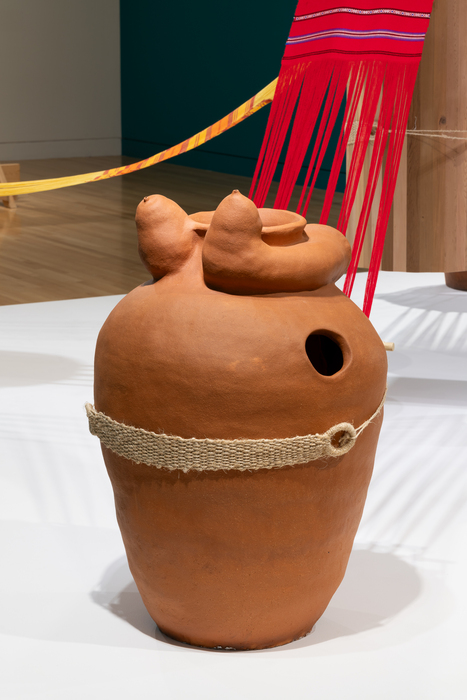

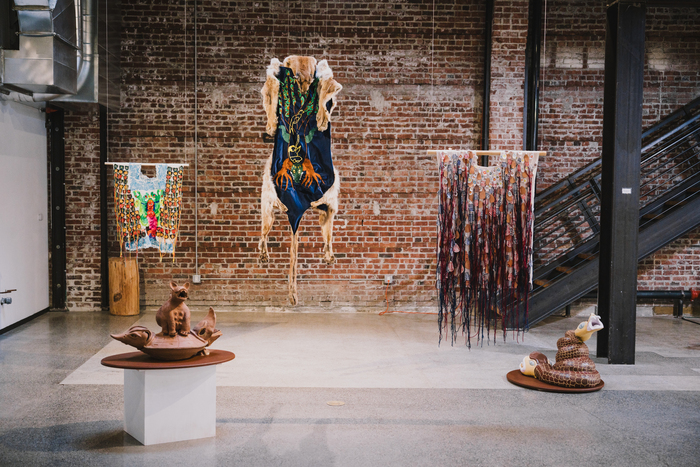
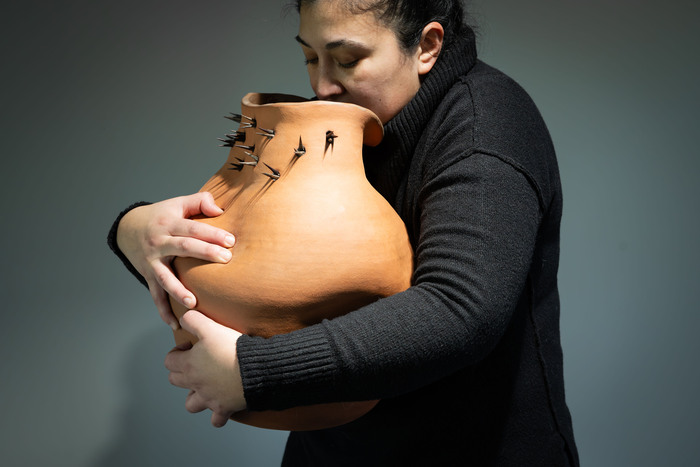
In this installation, the ceramic vessels evoke women's torsos, the cardinal directions, and a medicine wheel. When blown into, each vessel exhales like a deep wind that moves through the tree’s branches, echoing forces of nature now drowned out by urban noise
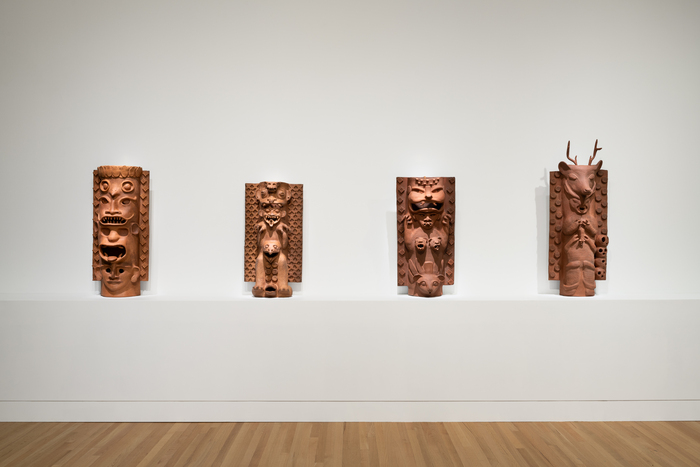
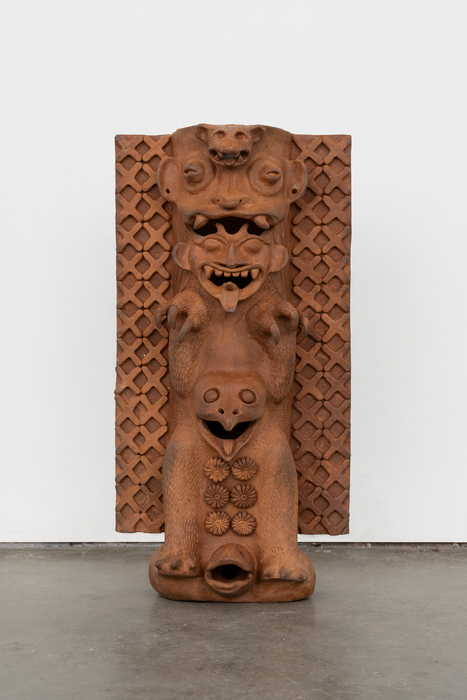
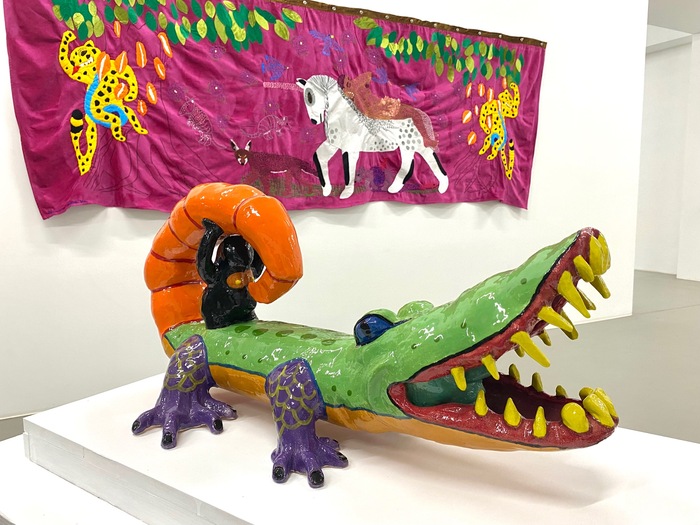
I created guardians and protectors of water and lands inspired by the Classical Maya period of freestanding censers. These guardians are hybrids of multiple animals strength coming today inspired by our past, to forge new mythologies for our political and social times—artwork that transcends time.
Based on an oral story my grandfather shared with us how rabbit betrays all his friends in order to get his antlers back. The beauty of oral stories tells us of the moral and ethical values of our societies.
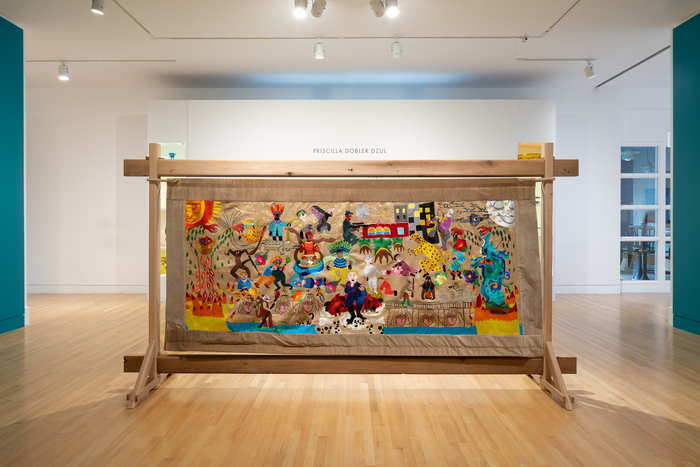
This work features two standing looms inspired by the version Dobler Dzul’s grandmother and mother used to weave hammocks. Each loom represents one of the artist’s two homes, Tacoma and the Yucatán, and holds two textiles: one that looks to the past, and one that confronts the present.
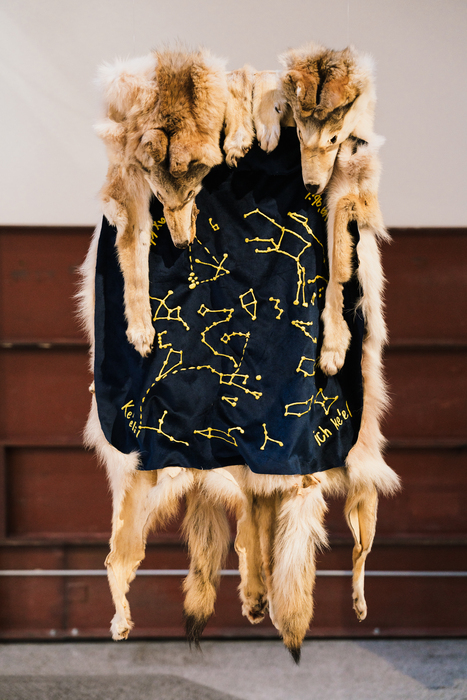
My family’s history is present in these materials and huipil dresses. Future Cosmologies is based around the oral stories my elders have shared with me, but also the research of cosmology and the impact it has had on our histories of travel, culture, and civilization.
I dedicate my labor and research to all my past ancestors for risking their lives migrating across jungles, deserts and oceans to create a prosperous future for myself and to continue passing the knowledge for the future ones to come. Map of our ancestors
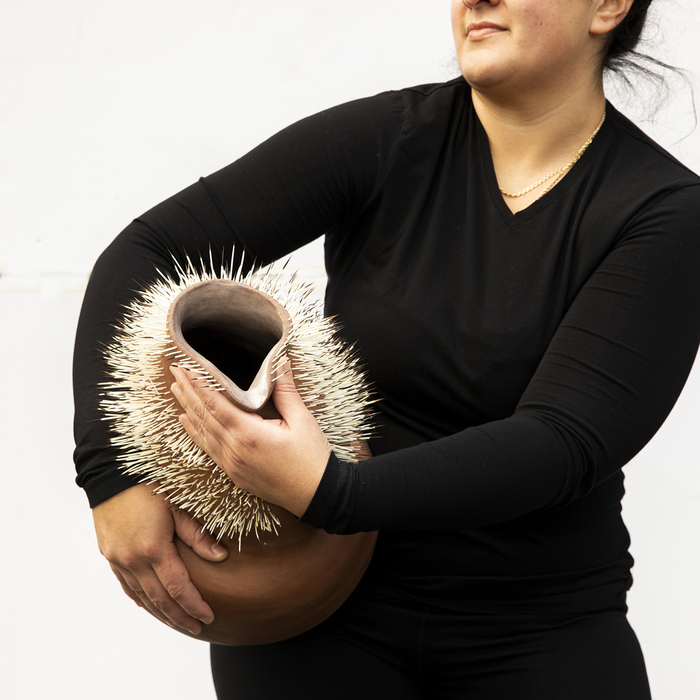
Each is coil built, manipulated and molded to engage with my body. It's about the relationship we have with our land, the histories we share with the ecosystems and the ancestral knowledge passed down through acts of labor. Through the laborious actions of serving, holding and performing.....
Each is coil built, manipulated and molded to engage with my body. It's about the relationship we have with our land, the histories we share with the ecosystems and the ancestral knowledge passed down through acts of labor. Through the laborious actions of serving, holding and performing.....
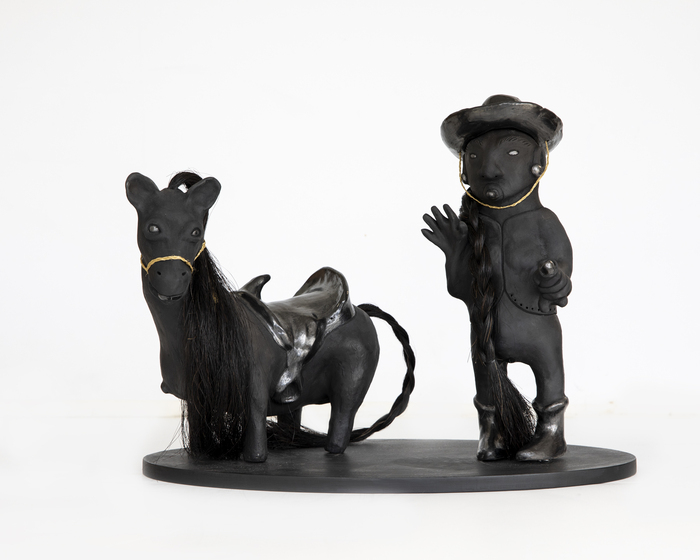
Work created in Oaxaca using barro negro techniques and process, to address not only the indigenous erasure but also the history of queer/lesbian cowgirls.
Artist’s Statement
My interdisciplinary practice spanning ceramics, sculpture, textiles, and film build narrative worlds that merge pre‑Columbian mythology, environmental science, and suppressed histories of resistance. Grounded in decolonial theory and biocentrism, my work centers the Indigenous oral traditions of my Maya ancestry, using research as both method and material. Within the field of contemporary Indigenous art, my practice is innovative in its hybrid approach: merging ancestral technologies with ecological science, sensory storytelling, and experimental material processes to challenge extractive colonial frameworks.
In The Four Winds gathered around Tree and her threads, I draw from millennia of backstrap weaving traditions to create vessel‑forms referencing women’s bodies, the cardinal directions, and the medicine wheel. Each vessel includes an Aztec death whistle—activated during performance—linking air, sound, and ritual. Henequen and backstrap weavings made in collaboration with a Maya elder, alongside tartan woven in honor of my Scottish grandmother, converge around a central Tree of Life. Similarly, The guardians remind us of what we have forgotten reimagines classic Maya censers as contemporary sculptures that transmit oral moral teachings through architectural patterning inspired by Uxmal.
My films integrate my grandmother’s huipiles embedded with ceramic tiles and henequen fibers, a method that sonically and materially evokes pre‑colonial trade networks across the Americas. As I move across land and water, the tiles activate the spirits carried through generations. In my Tacoma film, seeds and water—currencies of life before colonial extraction—travel with me as living protagonists.
My work emerges through years of experimentation, failure, and discovery across mediums. For seven years I have researched the ecological and cultural history of henequen, collaborating with a biologist to identify the singular bat species that pollinates the agave in Yucatán. Fieldwork in caves and jungles, exchanges with elders, and experimentation with natural dyes, weaving, and papermaking have expanded the material language of henequen beyond its colonial narrative.
In 2024, I co‑founded Wayak Chuy, a collective reviving the pre‑Hispanic Xmanikte cross‑stitch technique with Maya artisans. This commitment informs works like a conductive‑thread chair activated by a trilingual Maya myth, scented embroidered textiles grown in my garden, germination‑based sculptural pods, and tortilla presses reimagined as tools for printing identity onto masa. Across all mediums, I push technical, ecological, and narrative boundaries to expand how Indigenous futures can be imagined and experienced.