BRAVA Award Winner 2026 – Inge Bruggeman
Congratulations to our 2026 BRAVA Award Artists’ Books Artist winner, Inge Bruggeman!
The BIMA Recognizes Achievement in the Visual Arts (BRAVA) Awards are an annual award that honors four exceptional contemporary artists, craftspeople, or makers whose work demonstrates artistic excellence, technical mastery, and meaningful contributions to the arts community. The awards is presented in four categories, recognizing individual achievement and the broader impact these artists have had on the arts landscape.
Continue reading to learn more about this category, Inge Bruggeman, and her work.
Category: Artists’ Books Artist (United States)
The BRAVA Award for Artists’ Books Artists supports contemporary visual artists and craftspeople working in the genre of Artists’ Books. These works of art incorporate the concept of the book in various ways, often inviting the user to engage with them over time through interpretation, manipulation, or storytelling. Artist’s books can be small edition works or unique one-of-a-kind objects.
This award is open to artists working in a range of media, including but not limited to fiber/textile, painting, sculpture, printmaking, photography, installation, ceramics, and mixed-media or collaborative projects. The award is open to artists who live and work in the United States.
About Inge Bruggeman
I was fortunate to discover the book arts at a young age. As an undergraduate majoring in French literature, I found my calling in the Special Collections Department at UC Santa Barbara, where I studied with Professor Anne Cushing. Her course, ‘The Twentieth-Century Livre d’Artiste,’ set me on a path that has become a deeply fulfilling career spanning more than thirty years as an artist, educator, and member of the book arts community.
I now live in Berkeley, California, where I continue to make artwork and serve as Executive Director of The CODEX Foundation. I also teach a course in UC Berkeley’s Special Collections Department, ‘The Handprinted Book in Its Historical Context,’ which combines seminar and studio practice. In many ways, this work brings me back full circle to the experience that first inspired me as an undergraduate.
Much has unfolded between then and now—years I would describe as a continual balancing act between creating my own work and contributing meaningfully to the field.
After being introduced to the book as an art form as an undergraduate, I found my first mentors in Harry and Sandra Reese of Turkey Press. They gave me a grounding in both the conceptual framework and the mechanics of bookmaking. “It’s all about the work,” they said, emphasizing a life with art at the core of everything.

After graduation, I worked in the Art Department to build my portfolio before pursuing an MFA in the Book Arts Program at the University of Alabama. There, I met my second mentor, Steve Miller, who stressed the importance of craft and community. He encouraged me not only to refine my skills but also to engage with the broader book arts world—introducing me to the Penland School of Crafts, where I later taught many times. He urged me to join organizations such as the Guild of Bookworkers and even to become involved at the board member level for groups like the North American Hand Papermakers.
Miller showed me how special the book arts community is and instilled a commitment not only to making the work but also to supporting the field and those within it. I went on to serve as site host for two Paper & Book Intensives and a Guild of Bookworkers conference, and made volunteering a consistent part of my practice. More recently, I served as Journal Editor for the College Book Art Association’s ‘Openings: Studies in Book Art,’ and as Board Chair of the Fine Press Book Association. I have contributed in many ways, including serving as a juror for several prestigious awards, and I continue to do so, currently serving as the juror for the MCBA Artist Book Prize. In 2019, I was honored with the Outstanding Alumna Award from my graduate program—an honor I share with the mentors who shaped my commitment to service.
After graduate school, I was awarded a two-year residency at the Minnesota Center for Book Arts (MCBA), where I served as the letterpress studio resident and continued developing artist’s books under my imprint, INK-A! Press. At MCBA, I oversaw their Winter Book production and began teaching workshops. By this point, it was clear that artists’ books offered a richly complex field—at the intersection of craft and concept, history and contemporary practice, form and content, and the interplay of text and image—full of expansive possibilities.
Since those early years, I have maintained an active practice as both artist and researcher: exhibiting internationally, teaching at various institutions, and working as a writer, curator, and publisher. After MCBA, I held a Lecturer position at UC Santa Barbara before moving to Portland, where I taught for many years at the Oregon College of Art & Craft. Initially, I resisted a traditional full-time academic path, choosing instead to teach part-time while developing my own work and running a letterpress and book arts business called Textura. I ran this business for ten years, which included collaborations with local artists, poets, and designers, as well as printing books for publishers such as Granary Books in New York.
During my time in Portland, I received an Individual Artist Fellowship from the Oregon Arts Commission and the Leslie Durst Individual Artist Fellowship, along with numerous additional project and travel grants from city and state organizations.
Eventually, full-time academia called, and a sabbatical replacement position in the MFA program at Columbia College Chicago helped me transition into full-time teaching. My academic career culminated in a tenure position at the University of Nevada. As Professor, I directed the Black Rock Press in the Art Department and expanded the book arts curriculum from a single elective into a robust program. I also launched a fellowship program to support emerging book artists. Under my leadership, the Press received an Institutional Award from the American Printing History Association, and I was honored with the 2020 Dean’s Award for Outstanding Research & Creative Activity. Being an artist in academia brought many opportunities. A few highlights include: giving the Mitchell Lecture at the University of Iowa; visiting Newfoundland, Canada as a visiting artist; being invited to exhibit and lecture at a conference sponsored by Jack Ginsberg in Johannesburg, South Africa; completing a summer residency in Marseille, France at the Atelier Vis-à-Vis; being selected by Buzz Spector to go to Haining, China to give a talk and participate in exhibitions; and giving a lecture as part of a symposium at the Legion of Honor Fine Arts Museum in San Francisco.
After 25 years in academia, an opportunity emerged to serve the wider book arts community in a more expansive and sustained way. As Executive Director of The CODEX Foundation, I am now in a unique position to advocate for the field on an international scale. Through the publishing, exhibitions, and programs that CODEX organizes, I am able to foster connections across a global network of artists, scholars, and institutions. This work brings together the elements that have long shaped my own creative practice as well—education, dialogue, scholarship, and community.
Learn more about Inge on her website.
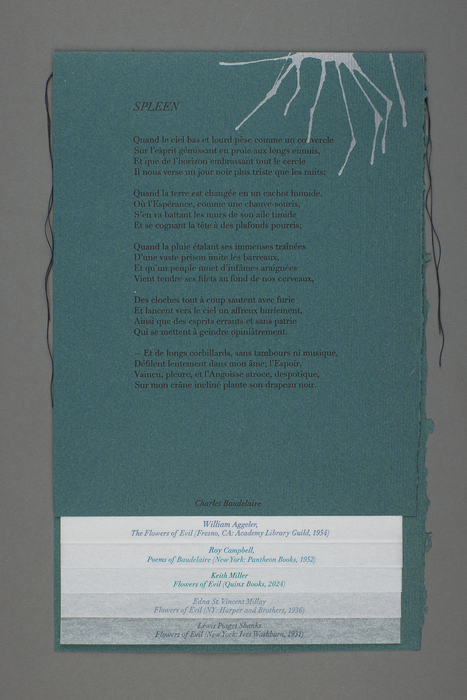


A folded pamphlet with a poem by Charles Baudelaire in French on the cover. The poem is from "Spleen" and speaks of a national darkness that parallels our current political situation. The poem is printed in black with a silver ink blotch that looks like a spider's legs.
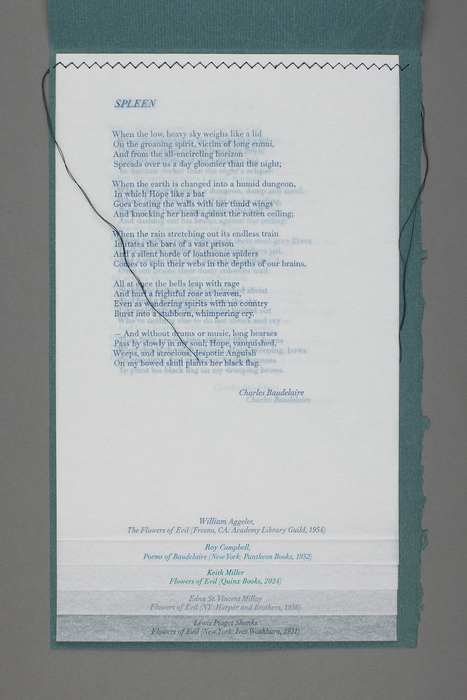
This detail shows the inside pages, printed slightly misaligned to create a visual blur. One can read each wildly different translation of the poem or experience the blend of all of them together. The pages are sewn together leaving threads hanging to play with the idea of the spider's web.
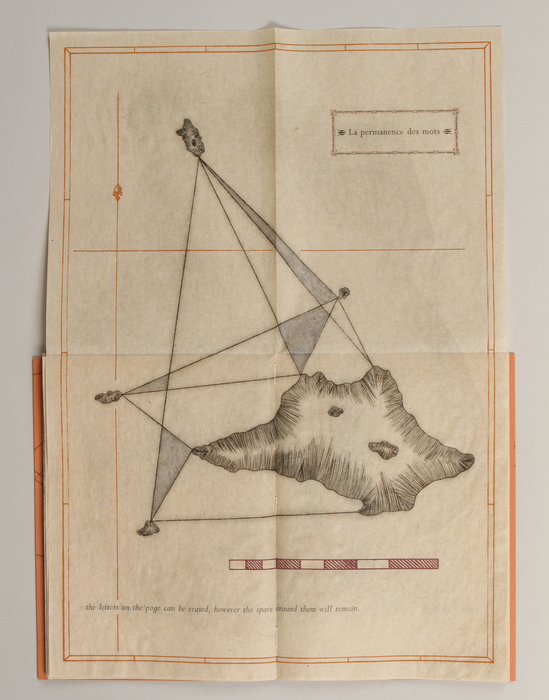
This edition was created during a residency in Marseille, France. Inspired by the 18th-century sea explorer Laperouse, the book attempts to map the space between the known and the unknown, while noting the misguided notion that a comprehension of the unknown comes through ownership and renaming.
This image shows one of several map-like fold-outs. The book is printed on Akatosashi paper using several techniques: drypoint etching, serigraphy, letterpress printing from metal type and photopolymer plates, monotype, and pochoir.
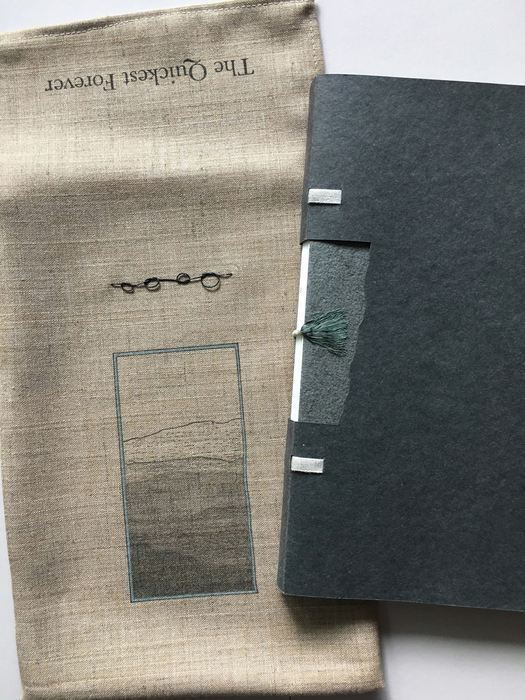
The book is bound w/ a cut-out on the spine to reference the book itself as a kind of geological artifact with its layer or strata of pages and histories. It comes in a printed linen bag. The images are drawings, made into polymer plates that were hand-colored, and thread is used as imagery as well.
Inspired by the life & work of one of the first female American botanical/scientific illustrators, Orra White Hitchcock. She made drawings on linen for husband's geology course in the 1800's. The book is about contrasts, language, the records we leave behind, (im)permanence, & the passage of time.
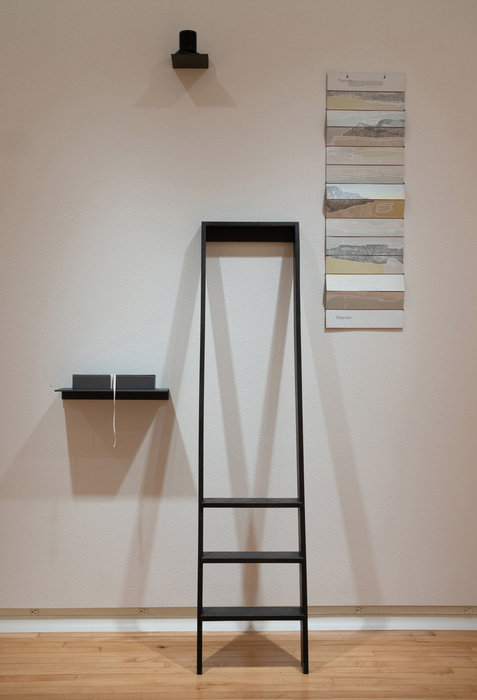
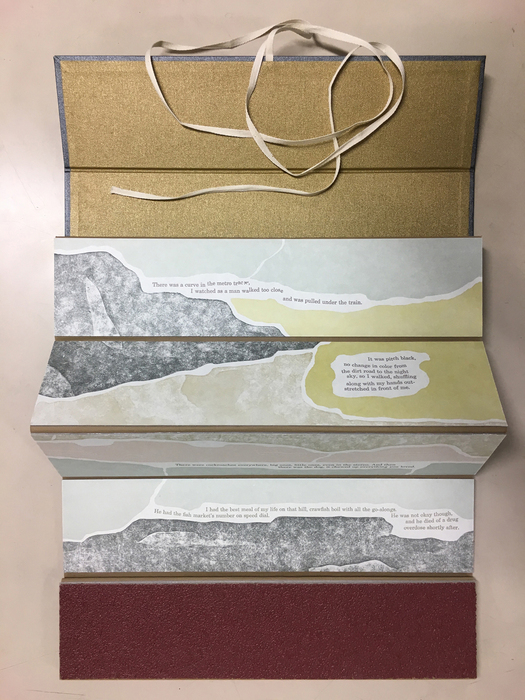
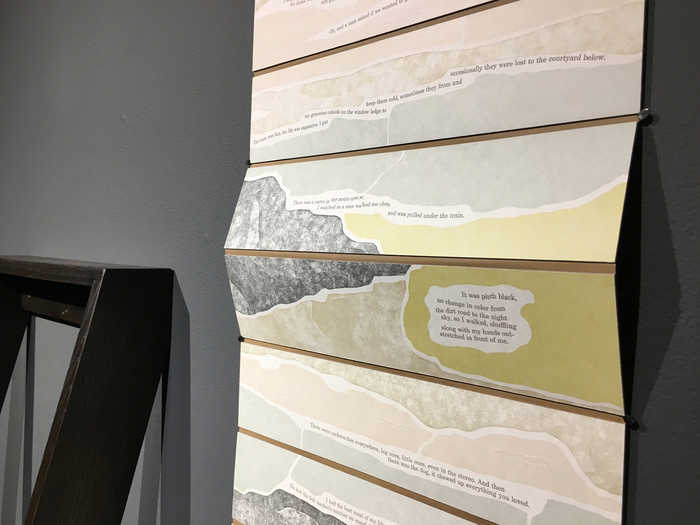
One artist book hangs on the wall, while another sits on a shelf as an artifact. A sound element emits a quiet overlapping & layered voice, beckoning the viewer up the ladder to view the book: impactful memories appear fossilized in geological strata, events like pebbles in our own bodily tissue.
The book is an artifact of the installation and was made in an edition of 15. It is covered in course belt sandpaper on one side and letterpress prints on Asuka paper on the other. Comes in a silver and gold portfolio wrapper with a linen and metal hook tie.
This project began as part of a summer residency at the Minnesota Center for Book Arts. I used their metal type to hand-set the text in an unconventional way to make it appear bent, shaped, and formed by geological pressures underground. Letterpress printed using type, collagraphs, and linoleum.
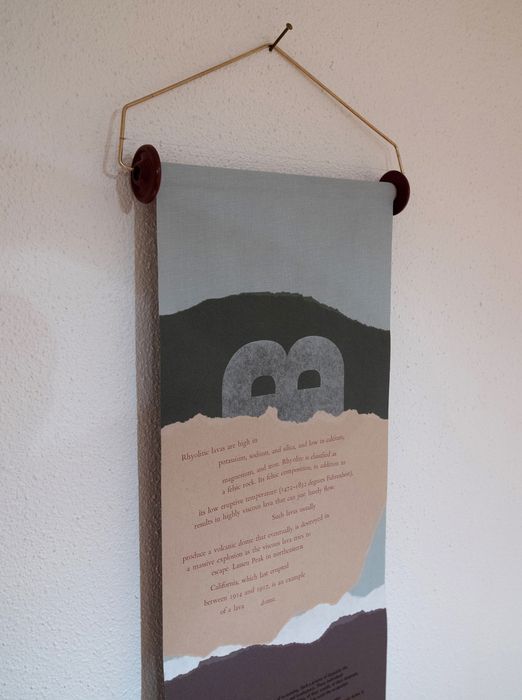
Series of 4 hanging works based on the player piano scroll form. This piece uses appropriated pages from old textbooks on lava and also on how language has been used as a tool to colonize new territories. Created during a residency at the Penland School of Crafts.
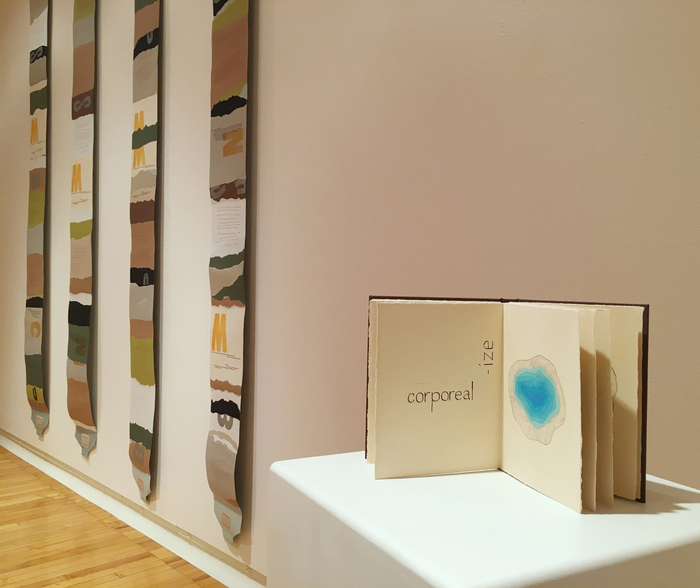
Exhibition view of "Principles of Lava & Language." Much of the work in this exhibit references geological strata and the book as a geological artifact itself. "Words & Rocks," a unique artist's book with pen, pencil, and gouache can also be seen in this image.
Artist’s Statement
For centuries, we have stored our lives in the ever-changing form of the book. We have used the book as a container to archive our histories, activities, and daily musings. We have drawn, scratched, stamped, etched, embossed, printed, and otherwise indelibly impressed ourselves on the page. The book is a shared cultural space, an object, and a symbol that we find in one form or another across the globe and throughout history. This relationship between the book and the people who create it is at the heart of my work.
My work revolves around the idea of the book — the book as object, artifact, and cultural icon. I am interested in work that investigates our personal and collective relationships to the shifting role of the book, print media, and text in our world today. I embrace a broad and interdisciplinary view of what the book can be, and how modern technologies can help us rethink and retool the book for more dynamic ways of visually and textually communicating information.
At the same time, my work has consistently drawn from archives and rare book collections for inspiration. My first artist’s book engaged the Marie Stopes Birth Control Collection at UC Santa Barbara, addressing women’s health rights. A more recent project, The Quickest Forever, drew from the Orra White Hitchcock Papers at Amherst College, honoring one of America’s first women botanical scientific illustrators.
I am currently working on a new book project using a poem by Oliver Wendell Holmes Sr. titled, ‘Cacoethes Scribendi,’ which indicates an insatiable or incurable urge to write. It is a short poem that I will overlap with my own imagery and text. The urge to transcribe our existence through writing can be seen as positive, and Holmes’ rhyming poem is somewhat innocent at first glance. On closer reading, however, it has a distinct layer of critique, warning the reader that this compulsion can be an unhealthy one. He uses analogies to the environment, and describes our apparent willingness to use up all the resources around us in our need to leave evidence of our short existence on this planet. I am researching artists like Cy Twombly and Antoni Tapies who abstractly approached these ideas in their work. I plan to focus on the tension between the beauty of writing in contrast with the compulsive need to capture the ineffable or to assert one’s existence through writing as a way to overcome our impermanence.
As part of this project, my goal is to resume working with handmade paper. I inherited some papermaking equipment and decided to create a papermaking collective with seven other artists. After looking for a space for about two years, we are finally getting set up this summer.
A series I continue to work on playfully investigates how “active reading,” or the exaggerated physical engagement with a book, can affect how we retain information. The first book in this series is meant to be read while walking. ‘No one wants to play the victim no one when there is a gun involved and blue’ was written by Laura Wetherington, while the book conception, design, and production were done by me. The book is installed on thirty-six feet of three-foot modular shelving built specifically for the piece. By walking and reading, the person interacting with the work paces the reading with every step, digesting the work in an embodied way. The second work in this series is ‘Deposits’. It is inspired by Southeast Asian palm-leaf book structures and also by the structure of the famous French avant-garde book, ‘La Prose du Transsibérien…’ (1913), by Sonia Delaunay and Blaise Cendrars. This book can be read like a book, but in its installed version, it hangs on the wall vertically and is meant to be read while ascending and descending a short ladder. A sound element of spoken text up high on a shelf beckons the reader/viewer to climb. The book represents a kind of geological artifact in itself (layers of pages, folios, and signatures — accumulations of words, texts, memories, and stories). Can a physical experience be held, fossilized in the very strata (muscles and tissues) of our body? How are the book and the body connected?
I am also deeply interested in language and the use of text in contemporary art. Bruce Nauman has described, “…identifying the point where language starts to break down as a useful tool for communication, [as] the same edge where poetry and art occur.” I frequently focus on this tipping point where language seems to lose its usefulness and falls into more ambiguous territory. Concepts surrounding linguistic pitfalls, shortcomings, and misunderstandings become the foundation for some of my editions and artworks. I am intrigued by how we read and process textual and visual information, and oftentimes, the visual nature of text becomes more important than its legibility.
My work has been exhibited and collected internationally and can be found in museums and academic collections such as the British Library, Wits Art Museum in Johannesburg, Getty Research Institute, Stanford University, Columbia University, Fogg Art Museum at Harvard, Haas Arts Library at Yale, Walker Art Center, Portland Art Museum, Nevada Museum of Art, and the Bainbridge Island Museum of Art, among many other private and public collections. I am the recipient of the Lia Libros de Artistas International Artist’s Book Prize, and was invited to Guadalajara as a visiting artist to participate in events surrounding this exhibition.
As part of my artistic inquiry, I have curated several exhibitions over the years that have included my writing and curatorial statements in accompanying catalogs such as: Turning Pages: Digging Through Time (Centre du Livre d’Artiste en Bretagne, 2024), Expanded Readings: The Book to Come (Sheppard Gallery, UNR, 2017), American Desk: A Selection of Ten American Artist Bookmakers (Rencontres Internationales de L’Edition de Création à Marseilles, Atelier Vis-à Vis, 2008), Fresh Impressions: Letterpress Printing in Contemporary Art (Hoffman Gallery, OCAC, 2007).