BRAVA Award Winner 2026 – RYAN! Feddersen
Congratulations to our 2026 BRAVA Award Native American & First Nations Artist winner, RYAN! Feddersen!
The BIMA Recognizes Achievement in the Visual Arts (BRAVA) Awards are an annual award that honors four exceptional contemporary artists, craftspeople, or makers whose work demonstrates artistic excellence, technical mastery, and meaningful contributions to the arts community. The awards is presented in four categories, recognizing individual achievement and the broader impact these artists have had on the arts landscape.
Continue reading to learn more about this category, RYAN! Feddersen, and her work.
Category: Native American & First Nations Artist (Salish Sea Region)
The BRAVA Award for Native American & First Nations Artist supports the work of contemporary visual artists and craftspeople who self-identify as Native American and/or First Nations. The award is open to artists working in a variety of disciplines, including but not limited to painting, sculpture, weaving, textile, carving, printmaking, photography, video, performance art, beading, installation, pottery, and mixed media or collaborative projects. Artists may work in both contemporary and traditional styles and content.
This award is open to any Native American & First Nations artist who lives and works in the Salish Sea region territories, including Skagit, Snohomish, King, Pierce, Thurston, Mason, Jefferson, Whatcom, Clallam, Kitsap, Island, and San Juan Counties in the U.S. and Alberni-Clayouquot, Capital, Cariboo, Comox Valley, Cowichan Valley, Metro Vancouver, Mount Waddington, Nanaimo, Powell River, Sunshine Coast, and Thompson-Nicola areas in Canada.
About RYAN! Feddersen
RYAN! Elizabeth Feddersen specializes in creating compelling site-specific installations and public artworks which invite people to consider our relationships to history, culture, the land, and our non-human-kin. She completed a Bachelor of Fine Arts at Cornish College of the Arts in 2009, and is now based in Tacoma, Washington. Feddersen grew up in Wenatchee and is an enrolled member of the Confederated Tribes of the Colville Reservation, from the Okanogan and Arrow Lakes bands, and of mixed European descent.
Her practice focuses on creative problem solving to address social issues through visual allegories that provide opportunities for exploration, introspection, and epiphany. She investigates creative strategies to activate engagement through interactive materials, community sourced content, social practice, fun, and humor. These approaches enable her work to start conversations about a broad spectrum of subjects and promote collective learning. Feddersen has created large-scale site-specific pieces and interactive installations throughout North America and has a growing body of permanent artworks in the public realm.

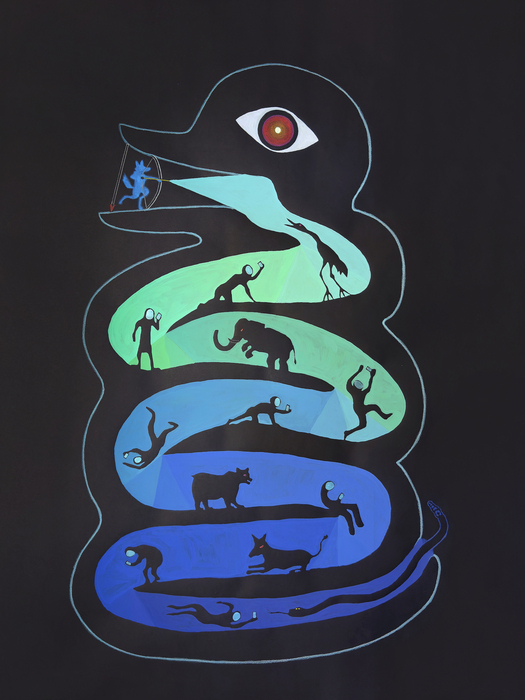

Coyote enters social media's jaws and uses his shoo'-mesh bow to illuminate the dark recesses of its power. He confronts a series of palace guards, some from traditional stories, others representing current, political, and national identities.
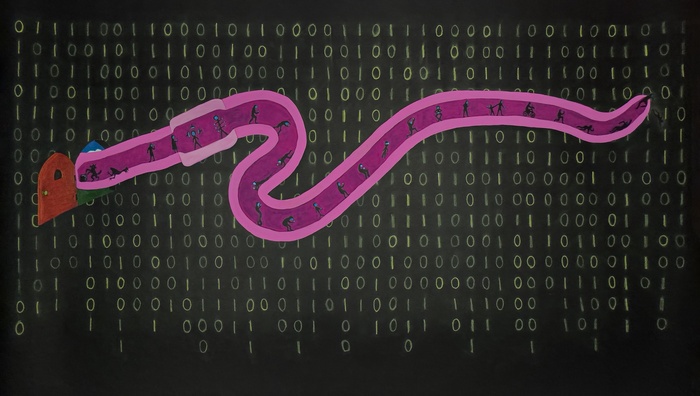
Coyote discovers that the people have been hijacked and are trapped in the digital realm. As the binary code reads, ‘hypnotized by hate and desire humanity's antisocial drives have taken control.’ Coyote, determined to rescue the people, takes control of the monster, steering it off the internet
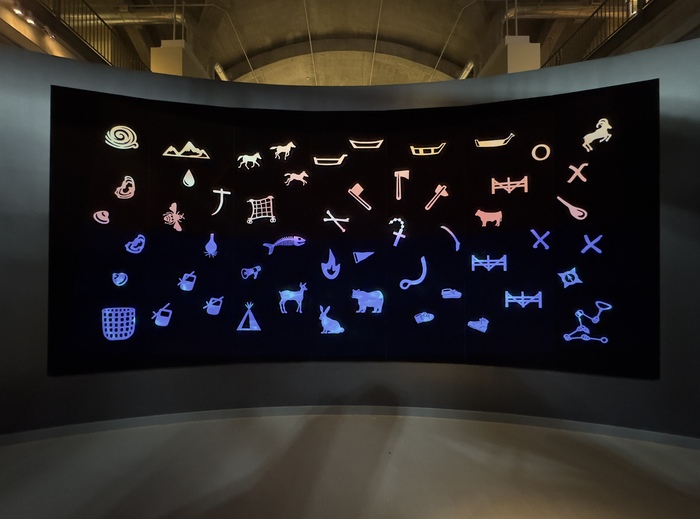
"To See a Dawn" is an homage to the petroglyphs and pictographs inundated in the dam building era featuring an array of glyphs that draw on imagery and events from each key learning within the Washington State History Museum's This is Native Land exhibition.
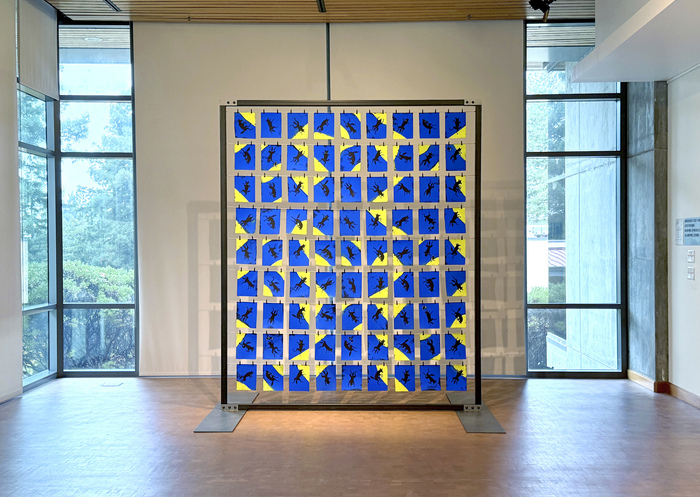
This piece emphasizes persistence in the face of failure, where each time Coyote perishes, he is revived in the river so he can try again. Displayed with Coyote hung up to dry.
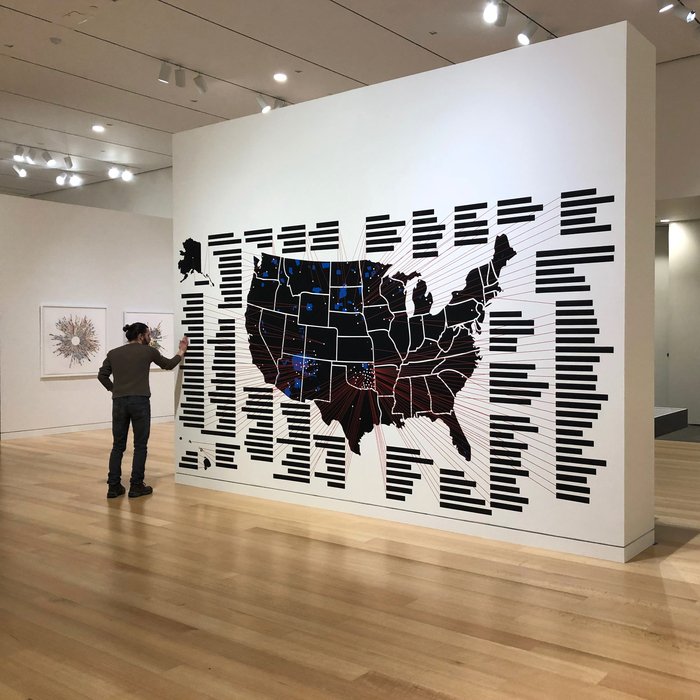
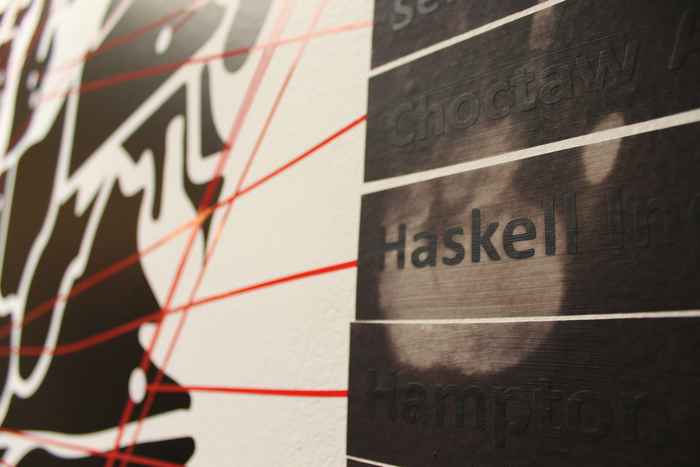
The piece depicts systems of state-sponsored cultural genocide: Indian Removal Policy, And Indian Boarding Schools, histories expunged through propaganda. The audience was invited to reveal the facts as the black bars were coated in ink that was turned translucent by body heat. Wellin Museum, NY.
The piece depicts systems of state-sponsored cultural genocide: Indian Removal Policy, And Indian Boarding Schools, histories expunged through propaganda. The audience was invited to reveal the facts as the black bars were coated in ink that was turned translucent by body heat. Wellin Museum, NY.
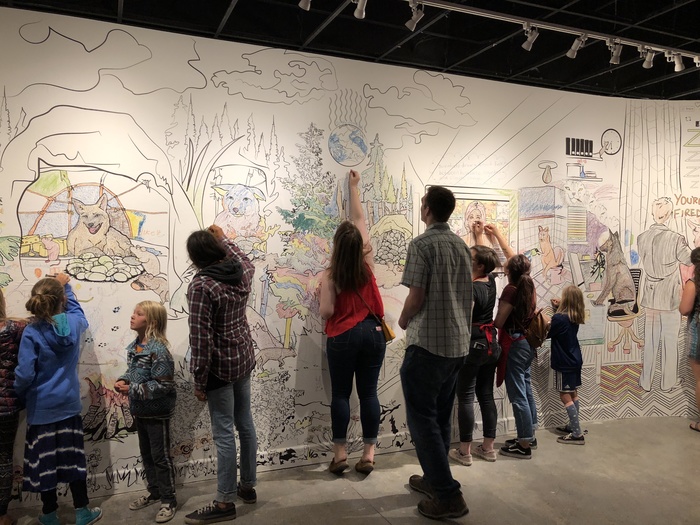
The project was an invitation to think about the trickster, Coyote, as an active player in contemporary events through a large collaborative drawing & coloring installation. Paired with crayon cast Coyote bones, his immortality becomes metaphorically linked to creativity.
"Bison Stack Crane" ties the mass slaughter of the bison, and systematic removal of native peoples from their lands, to current continuing trends of rapid redevelopment and displacement of people and animals in many of America’s major urban centers.
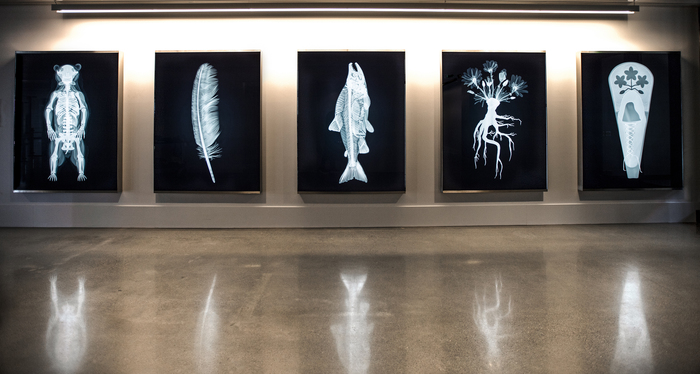
“Antecedents” is a set of five light-boxes which blend inspirations from scientific practice, concepts rooted in Plateau origin stories, and ruminations on our relationships with the life-forms and ecosystems with which we share the world.
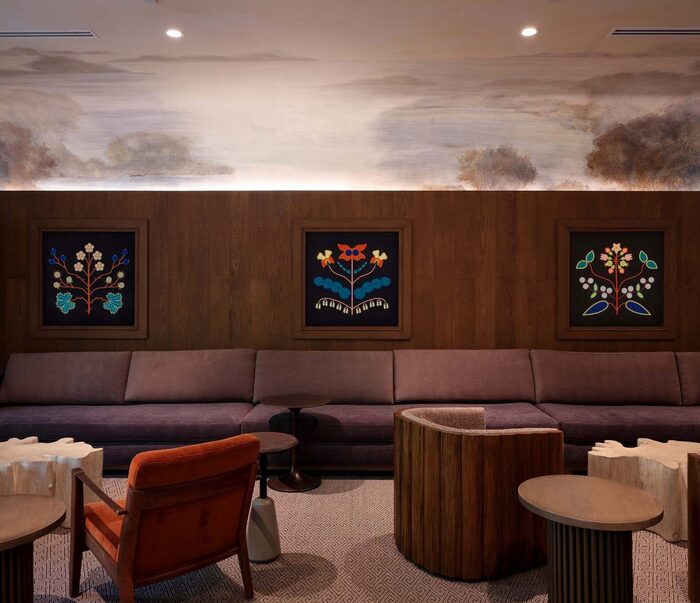
“Biologic Ethos” is a series of three floral motifs depicting multiple life stages of indigenous plant species through compositions that carry forward Interior Plateau bead working traditions. Each motif represents a single plant species shown in various seasons.
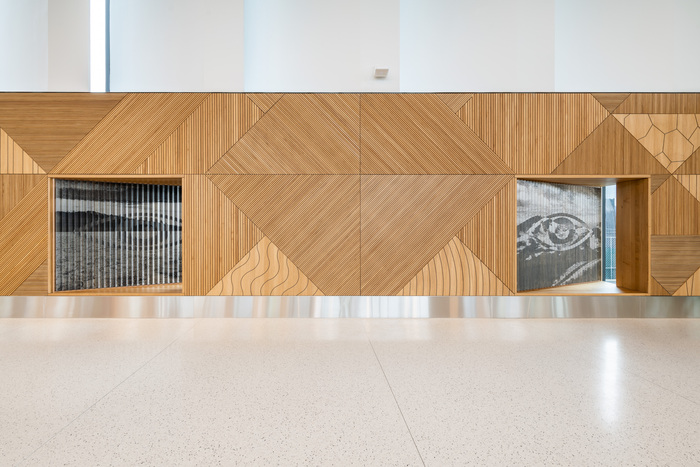
“Inhabitance” is a series of three interconnected artworks which highlight the diversity and significance of Pacific Northwest biomes.
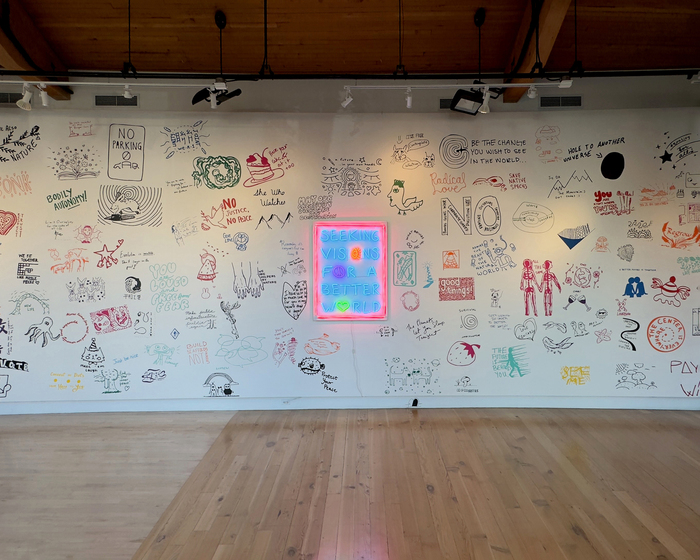
This piece was a call for images and aspirational sentiments that invoke constructive visions of the future to counterbalance the preponderance of dystopic visions presented in pop-culture and media. Contributions were translated into graphic treatments, progressively saturating the gallery.
Artist’s Statement
My practice playfully applies creative strategies to activate engagement and provide opportunities for exploration, introspection, and epiphany. My artwork is often immersive and interactive, creating situations where people experience concepts and participate in ways that reinforce the ideas embedded in the work. In this sense, many of my works can be viewed as community performed metaphors.
I use inventive materials to experiment with ways symbolism can be paired with materiality or action to enhance content. Developing methods that are participatory, crowd-sourced, socially engaged, and involve play, touch, or movement has led me to cross boundaries between printmaking, sculpture, digital media, and performance.
Community research is also important to my process. I approach this in various ways including gathering participation generated content, interviews, as well as collections and archival research. I then process and share the information I have gathered through artwork.
These community-focused practices facilitate many project-based artworks which are unique in their approach and content. Examples include Coyote Now, an invitation to think about the trickster, Coyote, as an active player in contemporary events through a large collaborative drawing & coloring installation in which Coyote’s antics comment on current societal problems. Paired with crayon cast Coyote bones, his immortality becomes metaphorically linked to creativity; Seeking Visions for a Better World, a call for images and aspirational sentiments that invoke constructive visions of the future to counterbalance the preponderance of dystopic visions presented in pop-culture, literature, and media. I worked with a local neon studio to edition signage paired with community-sourced contributions that were translated into graphic treatments, progressively saturating the gallery; Kill the Indian, Save the Man depicts two systems of state-sponsored cultural genocide: Indian Removal Policy, and Indian Boarding Schools, histories expunged through censorship and propaganda. Through touching the artwork, the audience was invited to uncover the names and locations of boarding schools, as the black bars were coated in ink that turned translucent from body heat, revealing the words underneath; Inhabitance, an immersive series of artworks in the Portland International Airport, where ‘Sentinels’ representing each regional biome confront humans with a massive watchful eye revealed through a lenticular structure; Antecedents, a series of 5 light boxes in the University of Washington Population Health building which mimics x-rays to reinforce and connect storytelling to diagnostics, reminding scientists to consider our relationships with the life-forms and ecosystems with which we share the world; and the series Coyote and the Monsters Yet to slay, addressing social issues through the lens of Plateau lore, including Coyote and the Wormhole and Coyote and Lil Brother, which embody our social problems as monsters that Coyote can then symbolically slay, and Coyote Tries Again, an installation of 81 prints which emphasizes persistence when facing failure, where each time Coyote perishes, he is revived in the river so he can try again.
Each artwork invites people to consider our relationships to history, culture, the land, and non-human-kin. We can decide to live in better relationship to the land and each other.